
Articles / Product spotlight / 28 Sep 2026 / 4 min read
Spray-on PPF: what it is and how to source a peelable paint-protection system
No cutting, no seams, no edge lifting — a protective layer that is sprayed on like paint and peeled off like a film years later. We walked through the full application with the material factory; here is the honest version, including what the test reports should say.
Traditional paint protection film arrives as a roll. It gets cut, stretched and wrapped over every edge, and on complex bumpers and mirrors you either live with seams or pay a master installer to hide them. Spray-on PPF takes a different route entirely: a two-component liquid base is sprayed over the whole car, cures into one continuous transparent layer, and — this is the part buyers find hard to believe — peels off years later without damaging the paint underneath.
1. How it differs from film — in practice, not in marketing
- No cutting on the car. Film installers cut with blades near your paint; one slip is a scratch. Spray-on never touches the paint with a blade.
- No seams, bubbles or lifting edges. Complex curves — mirrors, bumpers, door handles — are where film shows its seams. A sprayed layer is continuous by nature.
- Peelable. At standard film thickness the cured layer peels off in sheets when the owner wants it gone. The original paint underneath is untouched.
- Polishable and repairable. Dust points and fine scratches after curing can be sanded with #600 paper and polished — a repair film does not allow.
- Color-change friendly. The base cures clear. Spray water- or solvent-based color paint over the cured base, add clear coat, and you have a removable color change.
2. The system, end to end
A complete kit is more than two cans. The base material is a two-component polyaspartic polyurea: Part A and Part B mixed 3:1 by weight, thinned about 10%, stirred 3–5 minutes, then sprayed. Before that goes on, the car gets degreased and treated with a paint surface densifier — two sprayed coats on panels, wiped onto plastics. After the base cures, two coats of clear coat finish the job. Degreaser, thinner and clear coat are generic consumables most buyers source locally; only the base system is the special part.
3. The application, step by step
- Wash the whole car with degreaser.
- Spray the densifier over every panel — two coats; apply it by wipe on plastic trims.
- Mix A : B = 3 : 1 by weight. A full-size car takes roughly 7.5 kg of A and 2.5 kg of B, plus about 10% thinner. Stir 3–5 minutes; the pot life is 3–4 hours.
- Spray the base in continuous passes — around six coats, building to at least 180 microns.
- Cure: 60 °C for 30–40 minutes in a booth, or 3–4 hours at room temperature.
- Sand dust points or runs with #600 paper.
- Two coats of clear coat. Total film thickness lands around 240–260 microns.
The coverage arithmetic is the part that decides your economics: about 10 kg of mixed base per car. That is why we recommend buyers start with a trial kit rather than a pallet — one kit with four 3 kg cans of A, four 1 kg cans of B, densifier and two spray guns covers roughly one and a half cars and tells you everything about the material before you commit.
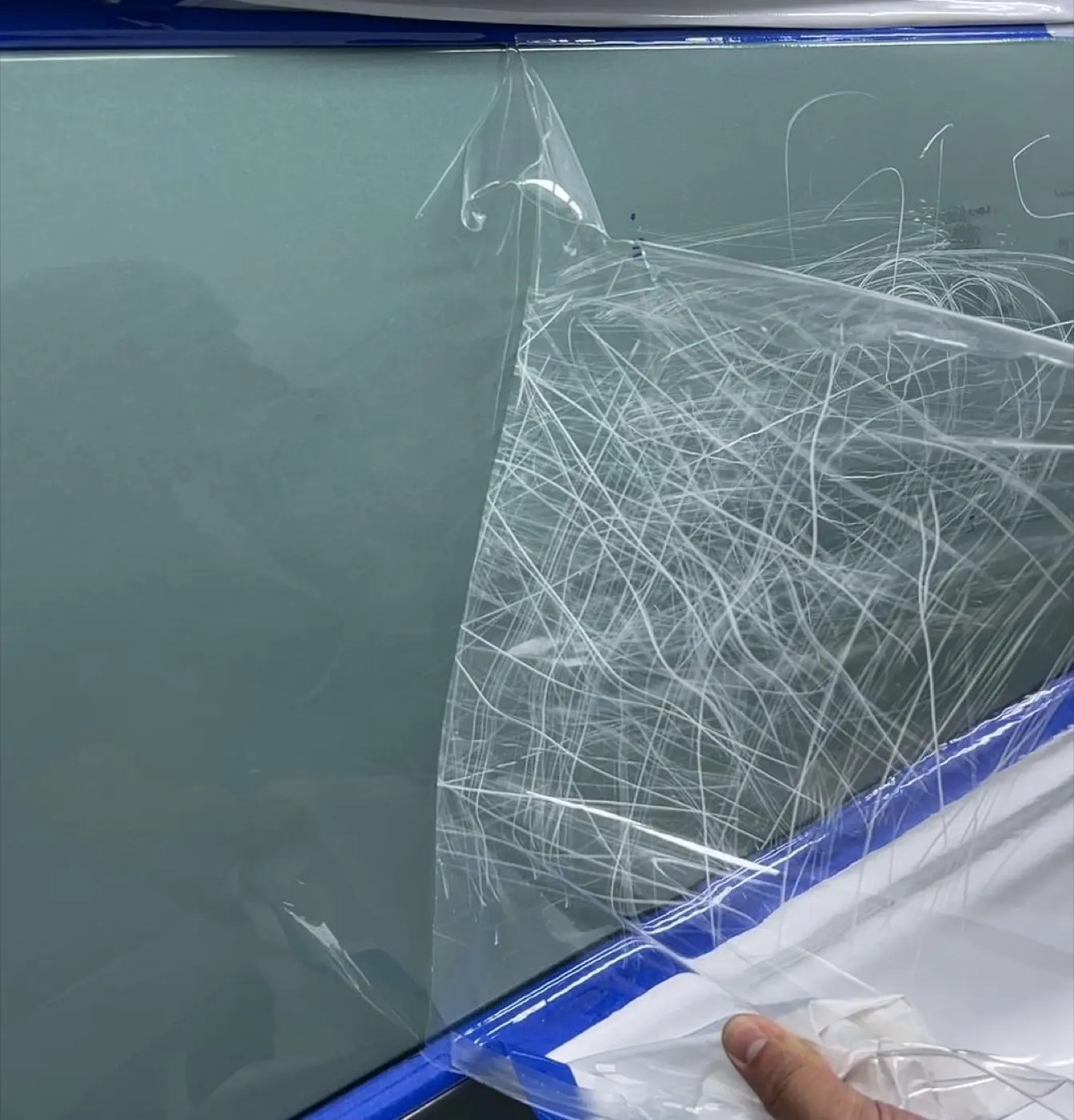
4. The test reports that actually matter
Any factory can print a glossy brochure. Three documents separate a real material from a repackaged one:
- A TDS with real numbers. Solid content, elongation at break, tensile strength, and — the one that matters most — documented peelability from original paint. Vague TDS, vague factory.
- UV aging test, not a sunlight promise. The serious standard here is accelerated weathering: UVA-340 exposure for 2,000 hours under a cyclic method like GB/T 14522-2008. On a pass result you want to see gloss loss, discoloration, chalking and cracking all at level 0 after the full 2,000 hours, with no visible change. Ask for the report number so you can verify it exists.
- SDS for every component. Part A, Part B, the densifier — a supplier who ships chemicals without safety data sheets is telling you how the whole relationship will go.
5. Who this product is actually for
Detailing studios adding a premium protection service, color-change shops that want a removable alternative to repaint, and fleet or lease-return owners protecting resale value. It is not a DIY product: the mix ratio, film thickness and cure window need a trained sprayer with a proper booth. That training burden is real — and it is also why the service commands good margins for the shops that do it right.
Quick answers
What is spray-on PPF?
A paint protection layer applied as a liquid instead of a film. A two-component polyaspartic polyurea base is sprayed over the car, cures into one clear continuous layer, and can be peeled off later without damaging the original paint.
Is spray-on PPF better than film?
It solves different problems. It has no seams, no lifting edges and no cutting near the paint, and fine scratches can be sanded and polished. Film needs no spray booth. Spray-on suits shops with a booth and a trained sprayer.
Can spray-on PPF be removed?
Yes. At standard thickness the cured layer peels off in sheets, and the paint underneath is untouched. Ask the supplier for documented peelability from original paint in the TDS.
How much material does one car need?
About 10 kg of mixed base for a full-size car, sprayed in around six coats, plus clear coat. That is why a trial kit is the sensible first order.